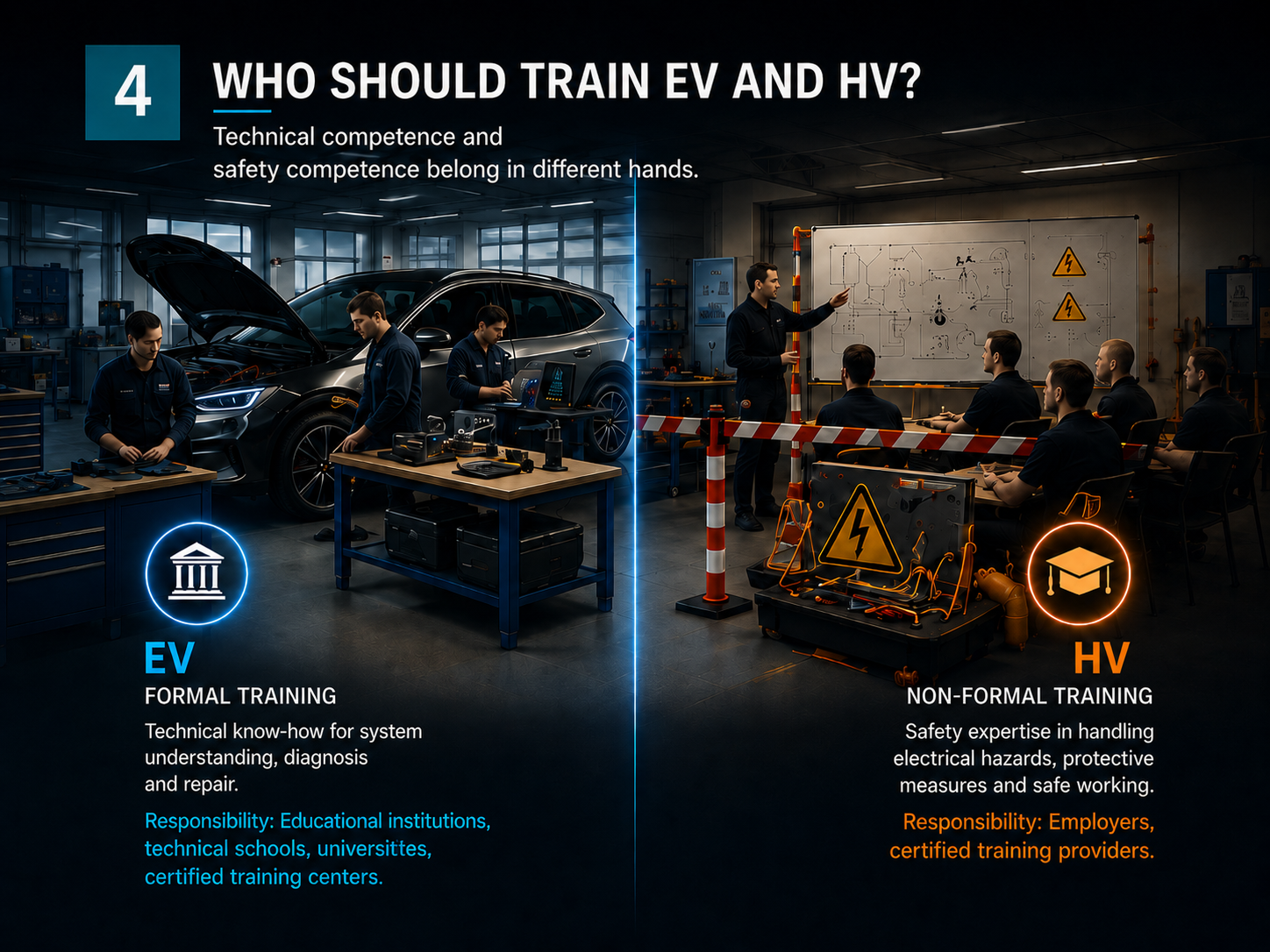
Why technical competence and safety competence require different educational pathways
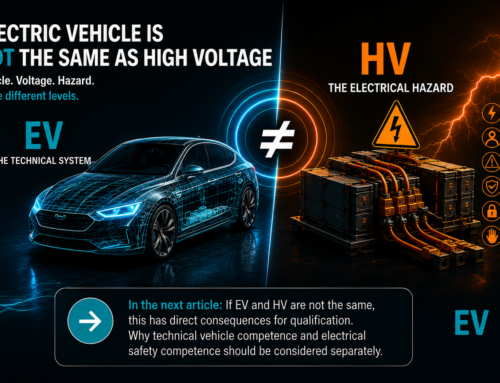
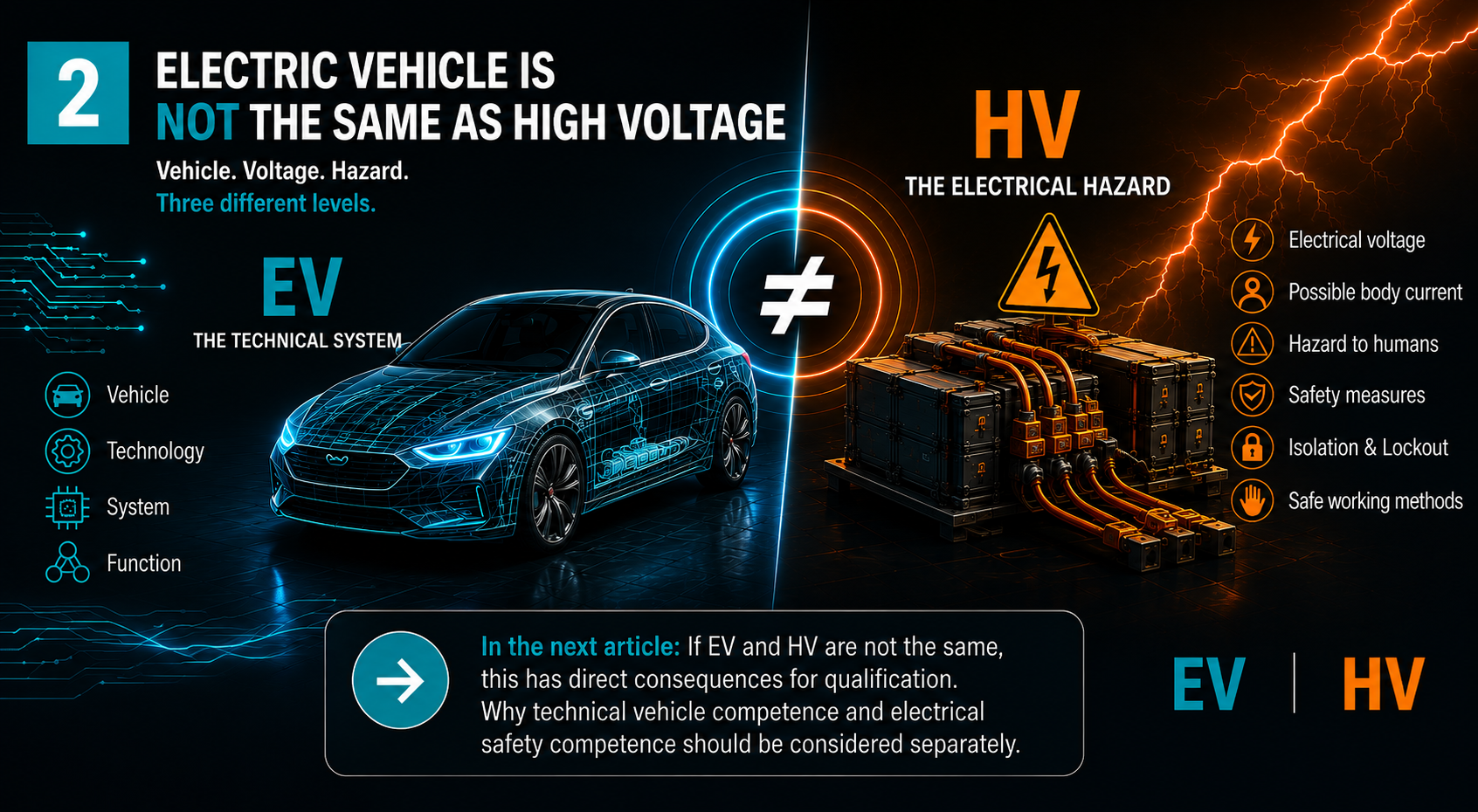
If technical EV competence and HV electrical-safety competence serve different purposes, the next question follows naturally:
Do both competencies need to be developed through the same educational pathway?
Not necessarily.
Separating EV and HV provides an opportunity to use existing education and training structures more effectively.
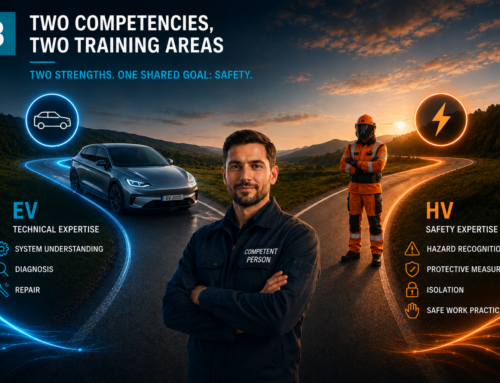
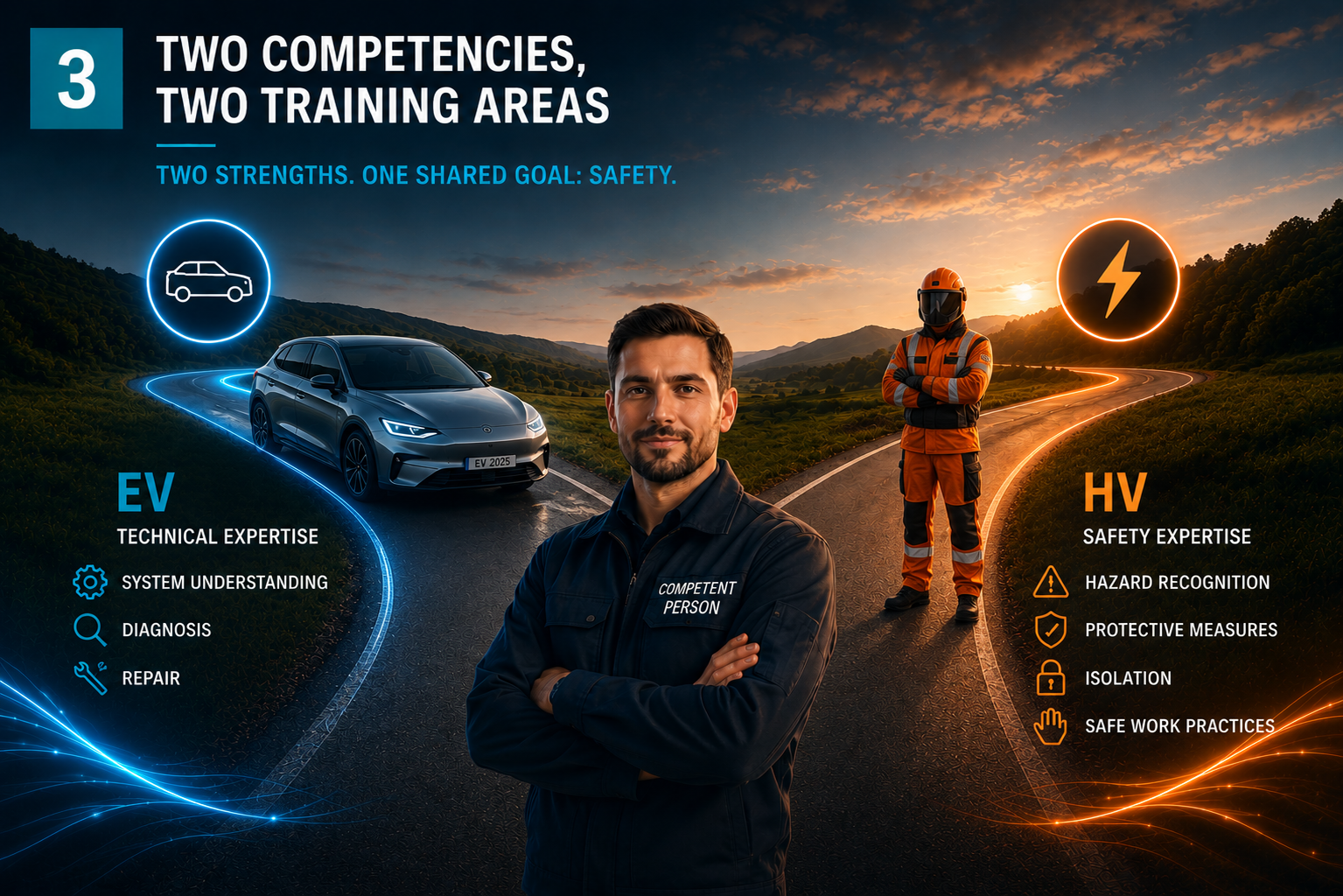
EV: Technical competence belongs in technical education
Electric propulsion is no longer a niche technology. Energy storage systems, power electronics, electric machines, charging and energy-management systems and diagnostics are increasingly part of mainstream vehicle technology.
EV competence therefore describes technical knowledge and skills such as:
- system and functional understanding,
- vehicle architecture,
- electric propulsion systems,
- energy storage and power electronics,
- diagnostics and troubleshooting,
- technical repair competence.
In the long term, these competencies should be primarily embedded in formal technical education: vocational education, technical colleges, universities and comparable recognised educational pathways.
The objective should be that future vehicle technicians no longer have to learn electric mobility as an additional qualification after completing their core education. It should become part of that core technical qualification.
HV: Safety competence is task-related
HV serves a different purpose.
Its primary question is not how the vehicle works, but how electrical hazards associated with a specific task can be controlled safely.
This may include:
- recognising electrical hazards,
- selecting and applying protective measures,
- securing work areas,
- isolating electrical systems,
- preventing reconnection,
- verifying the de-energised state,
- applying appropriate working methods,
- understanding the limits of one’s own competence.
A technically qualified person should not need to repeat an entire vocational qualification to acquire these additional safety competencies.
This is where structured non-formal training can play an important role.
Non-formal does not mean informal
This distinction matters.
Cedefop describes non-formal learning as learning through planned activities with defined learning objectives, time or resources and some form of learning support. Its outcomes may be validated and may lead to certification.
The European framework for micro-credentials likewise explicitly recognises formal and non-formal learning and a broad range of education and training providers.
The decisive question should therefore not only be where learning takes place.
It should be which learning outcomes are defined, delivered, assessed and demonstrated.
Three sources of competence instead of one “HV training course”
This leads to a clearer model:
EV – technical competence
→ primarily formal technical education
HV – electrical safety competence
→ primarily structured, task-related non-formal training
Product competence
→ manufacturer- or system-specific training
These three levels do not replace one another.
An HV safety course does not automatically make someone a vehicle technician.
A formal technical qualification, conversely, does not automatically demonstrate every safety competence required for every electrical task.
And neither EV nor HV replaces necessary manufacturer-specific knowledge.
A system with clearer responsibilities
The discussion can therefore move away from:
“Who is allowed to provide high-voltage training?”
towards the more precise question:
“Which competence needs to be developed – and which educational pathway is appropriate for it?”
This creates a clearer division of responsibilities without placing formal and non-formal education in competition.
They fulfil different functions.
Together, they can contribute to a complete competence profile.
In the next article
If EV and HV are understood as separate but combinable competence domains, we need a structure that makes these competencies visible and comparable.
What could a competence model from EV-1/HV-1 to EV-3/HV-3 look like – and why should a high level of technical EV competence not automatically imply a high level of HV safety competence?
That is the subject of Article 5: “From EV-1/HV-1 to EV-3/HV-3 – from course titles to competence profiles.”